
—
“What information are you driving around?” asks a pictorial warning widely shared by U.S. police departments. The advisory, which describes the sort of information that criminals could glean from the back of your car, suggests you might be endangering yourself and your family with stickers that reveal potentially sensitive details about your life.
Thanks to your careless exuberance, the illustration warns, bad actors may know the school your kids attend and the extracurricular activities in which they participate (an indication that you will be “gone most evenings and/or weekends for practices or games”). They also may know your hobbies (which might suggest you have “expensive equipment” at home or in the car), the sort of dog you own (possibly a little, nonthreatening breed), your place of work, and your spouse’s job (which might indicate frequent, prolonged absences).
By advertising your “baby on board,” the advisory adds, you signal that you are “an easy target” because you will be “distracted” and encumbered when you arrive at your destination. Even your personalized license plate might be risky, because it is more easily remembered by a hothead you “unintentionally offend” or a creep who “wants to keep track of” your vehicle.
“Always protect your personal information and limit what you share,” the Schertz, Texas, police department advises in a typical Facebook post. “What could seem like a harmless decal could lead to an unsafe situation.” In other words, drivers should guard their privacy, meaning they should be aware of the facts their cars might be divulging.
Meanwhile, the law enforcement agencies offering that advice have access to all this information and more, thanks to a nationwide network of AI-assisted cameras that photograph vehicles billions of times a week. The information collected by automated license plate readers (ALPRs), 137,000 of which had been mapped as of late August, goes far beyond what someone might surmise from studying the back of your car. It allows police to track your travels, identify other nearby vehicles, and even predict your itinerary.
Police can search that database on computers or mobile phones, conducting sophisticated queries that specify vehicle characteristics and locations, generate travel maps and route predictions, and use “convoy analysis” to show which cars have been spotted in a target’s vicinity. Cops can supplement that information with details from other government databases and publicly available records. They can do all that without any sort of judicial oversight and often without meaningful internal supervision.
As the companies that install ALPR cameras and their customers see it, the benefits of that warrantless surveillance system are clear: It helps detect, investigate, and deter crime, offering an affordable “force multiplier” that lets law enforcement agencies stretch their resources in ways that were previously impractical. But the technological innovations underlying that development raise obvious privacy concerns that judges and legislators have started to address only recently, two decades after ALPRs began proliferating as a law enforcement tool.
Flock Takes Off
Glenn Bronson, an electrical engineer and networking specialist who began tinkering with roadside cameras in 2013 and took several stabs at starting ALPR businesses, understands the technology’s potential benefits. But over the years, he has become increasingly worried by local governments’ tendency to install ALPRs without public debate.
Bronson’s interest in the subject was piqued by a thief who kept stealing metal from his family’s construction business in Connecticut. The burglar would show up before sunrise and walk through the woods to the back of the building, systematically removing and sorting machinery parts, fabrication steel, stainless steel, aluminum, copper, and brass. Then he would carry his loot to the road in front of the building and load it into his pickup truck.
Although Bronson had installed security cameras all over the property, the thief apparently disabled one that was low enough to reach and managed to evade the others, sometimes crawling on the ground to stay below a camera’s field of view while dragging material from the building. But it dawned on Bronson that the thief could still be caught after he returned to his pickup truck.
When Bronson researched the question, he discovered that it was perfectly legal to aim cameras at roads because it was taken for granted that people did not have a reasonable expectation of privacy in their public movements. Bronson set up his first roadside camera outside his family’s business in October 2013, and the surveillance enabled local police to identify the burglar, who was arrested in 2014.
The cops welcomed Bronson’s assistance in nabbing that guy and other criminal suspects, which suggested a business opportunity. Even a criminal who is careful to avoid detection by security cameras, Bronson realized, typically has to drive away at some point, exposing information that, with the help of ALPRs, can be used to apprehend him. Bronson continued to experiment with roadside cameras, including DIY devices and off-the-shelf equipment. He pitched them as crime-fighting tools to businesses, condo associations, police departments, and investors.
Bronson’s efforts to commercialize the concept ultimately did not pan out. But meanwhile, Flock Safety, an Atlanta-based company that another electrical engineer, Garrett Langley, launched in 2017 along with two fellow Georgia Tech graduates, made a go of it in a big way.
Langley, now Flock’s CEO, tells an origin story similar to Bronson’s. “He was troubled by how easy it was to break into cars in his neighborhood in Atlanta,” The New York Times reports. “When he asked police why they were unable to catch the thieves,” Langley told the Times, they said “they needed the perpetrators’ license plate numbers.”
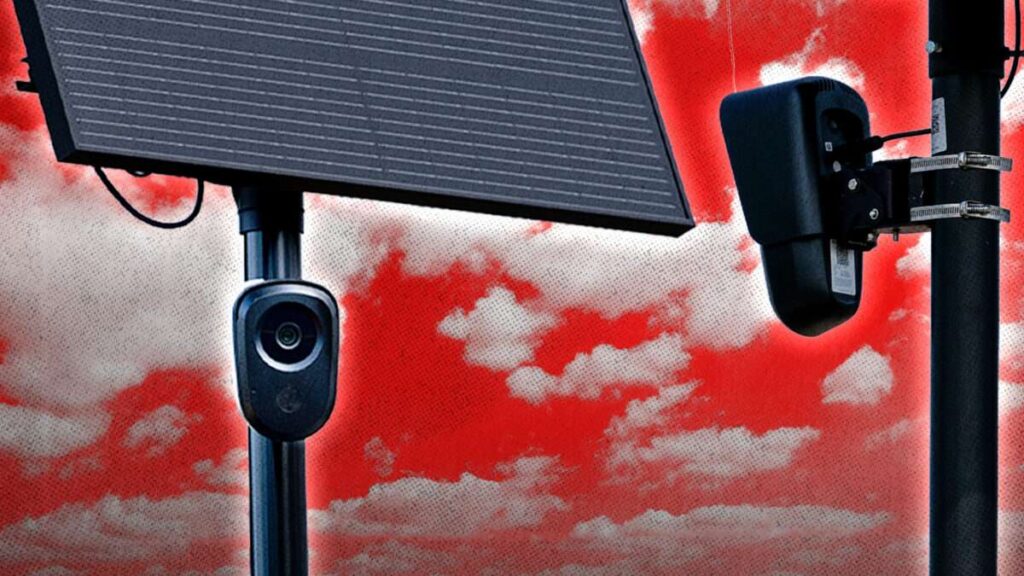
Flock started with homeowners associations, then expanded to police departments, offering solar-powered, internet-connected cameras that it promoted as boons to overtaxed law enforcement agencies. By 2025, Flock was reporting more than $300 million in annual revenue, and its self-estimated value was $7.5 billion, a number it later upped to $8.4 billion. The company, which says it has installed more than 120,000 ALPR cameras in 12,000 or so communities across 49 states, accounts for around 80 percent of the U.S. market. It also offers camera-equipped drones that it says can respond to service calls “anywhere in your jurisdiction” within a minute and a half.
Flock has contracts with about 7,000 law enforcement agencies, nearly 40 percent of the U.S. total, typically charging around $2,500 a year per camera, plus installation fees. In addition to providing the cameras, Flock maintains a database of license plate scans and alerts police when one of them matches a number on a “hot list” of targeted vehicles.
Flock also offers software aimed at maximizing the utility of ALPR data. Flock NOVA, for example, is “a real-time investigative and operations platform” that integrates data collected by the cameras with information from law enforcement records, “public records,” and “approved open sources.” That adds up to a lot of information, all of which can be tied to individuals by combining license plate numbers with motor vehicle registration records.
Bronson has watched Flock’s success with a combination of admiration and dismay. “Finding investigative leads should be as easy as shopping online,” the company declared in a Facebook ad that Bronson noticed several years ago. “Now it is.” To Bronson, who keeps a copy of that advertisement hanging on his wall, Flock’s pitch was alarmingly blasé about the privacy implications of its software. “I fell out of my seat when I saw that ad,” he says. “I could not believe it.”
Bronson, who still describes himself as “a roadside camera advocate,” also faults Flock for overselling the crime-fighting potential of its products. “I want crime to stop,” Langley told the Fox TV station in Milwaukee a few years ago. When asked if he envisioned “a future with a Flock camera on every street corner,” Langley did not flinch. “I envision that,” he said. “I envision an America where crime no longer exists.”
Langley re-upped that prophecy last year. According to Langley, Forbes reported, “Flock’s cameras, airborne and fixed, will eradicate almost all crime in the U.S.” within a decade. “I’ve talked to plenty of activists who think crime is just the cost of modern society,” he said. “I disagree.” He also rejected the notion of a tradeoff between security and freedom. “I think we can have a crime-free city and civil liberties,” he said. “We can have it all.”
The Crime-Fighting Potential of ALPRs
Bronson