—
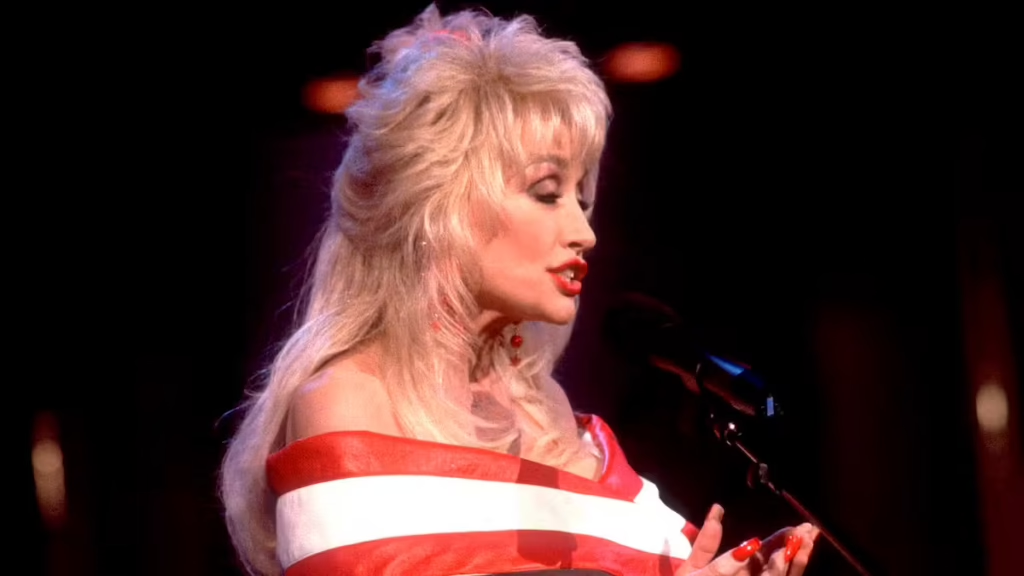
Dolly Parton was the greatest southern stateswoman of the 20th and 21st centuries. Forgive me a bit of hyperbole; the country star’s death at 80 has triggered an outpouring of grief and will no doubt be the source of thousands of well-earned and deserved eulogies and epitaphs.
Some might suggest it’s wrong to invoke the idea of a stateswoman for a figure so assiduously apolitical. Dolly was refreshing because she was not political even in moments where it was popular, or at least commonplace, to be so. Dolly managed to be friends with leftist icons such as Jane Fonda and a maternal figure to the deep red denizens of her home region. That she might have been a truly political figure, in that most classical and truest sense of the word, would have probably never occurred to her. Dolly’s legacy was more than music. It was also more than culture. Dolly Rebecca Parton Dean changed the fabric of society in her home region for the better, in ways that hundreds of thousands if not millions of Americans benefit from.
The world Dolly Parton entered in 1946 was not only poor; it was, by our standard, barely modern. She was born at her parents’ home, not in a hospital. That home was a one-room cabin that would have seemed rustic to people born one hundred years before she was. Dolly eventually had 11 siblings. Her mother had 12 children before the age of 35. Her father was an illiterate sharecropper. The Partons did not even have money to pay the missionary doctor who delivered Dolly. Her father offered a sack of cornmeal.
Sevier Country, Tennessee, was in the 1940s still remarkably poor at a time when the rest of Tennessee began to experience the government-sponsored prosperity of the Tennessee Valley Authority. FDR’s programs did not lift the Partons out of poverty. That work would be done by the small, wasp-waisted, blond daughter of Avie and Robert Parton.
Dolly Parton’s world was traditional without the benefit of the correct respect given to tradition-coded life from Zoomers. Music was celebrated because it was one of the few ways the often-barely literate or illiterate mountain folks passed on their traditions. Holiness Pentecostal religion offered a passionate faith in a place where day-to-day life was often marked by grinding poverty. Dolly Parton was everything that modern America should have hated: a poor, southern, uneducated hillbilly.
And yet America not only did not hate Dolly; it fell hopelessly, madly, uproariously in love with her. Her good looks and sweet voice certainly turned heads and melted the hearts of those who might have looked down on her. But Dolly’s true talent was being far smarter than anyone ever gave her credit for. It was that intelligence — so unsuspected from anyone born in to the poorest parts of the Smokies in the 1940s — that made Dolly more than just a singer and more than a cultural icon.
Dolly at times looked and sounded ridiculous. The rhinestones, and the syrupy but still somehow tasteful flirtation she used to charm her many admirers, might have led undiscerning observers to conclude she was nothing more than a musically talented bimbo from the sticks. But behind the façade lay the heart of a woman committed to the betterment of her people and willing to move mountains to accomplish her aims.
Plutarch wrote of the Roman general Fabius that some aspects of the latter’s personality “led those who knew him superficially to suspect him of something like foolishness and stupidity. Only a few discerned the inexorable firmness in the depth of his soul, and the magnanimous and leonine qualities of his nature.” And so it might have been for Dolly Parton, who nonetheless lived long enough for most of America to admit the depth of her soul and the undeniably magnanimous and leonine qualities of her nature.
Like a true lioness, Parton was fiercely protective of her mountain people. And like Fabius, Dolly avoided the large open-field political and social battles her time. She chose the ground she waged her war on in her battle to make the lives of Tennesseans better. And that ground proved to be entertainment and literacy.
Dolly Parton’s battle to make the lives of Appalachians better was an unmistakable success. And she fought to bring large-scale literacy to poor Americans. Dollywood employs over 20,000 people from across East Tennessee and creates almost two billion dollars in annual revenue for the region. Parton’s person is substantively responsible for the rise in tourism in Pigeon Forge, Gatlinburg, and Sevierville. Her foundations funded cutting-edge medical research and helped with natural disaster relief. She did all of this while also being one of the most important singer-songwriters in the last century.
It is perhaps trite to end with a nod to Parton’s “I Will Always Love You,” made so famous by Whitney Houston’s 1992 cover. Dolly undeniably made people love her; she was pretty and sassy and talented. But if the outpouring of grief around her death is any indication, many Americans by 2026 revered and adored her for reasons that evoke the passions solicited by the death of classical heroes, heroines, and statesmen, rather than those of a country or pop star.
In Dolly, we saw the America we wanted to exist. Pericles admonished Athenians during the Peloponnesian War “to fix their eyes every day on the greatness of Athens” so that they would fall in love with her. Dolly Parton was, for Americans, the embodiment of an America we could fall in love with. And at least in Dolly, we could see an America that really was great. What more could we ask for politically from someone who was not political?
***
Miles Smith IV is an associate professor of history at Hillsdale College.
This article is part of Upstream, The Daily Wire’s new home for culture and lifestyle. Real human insight and human stories — from our featured writers to you.