
—
Reason’s October 2026 cover story is an expansive exploration of prison reform in America:
Book One: Proto-Prisons and the Jacksonian Era (1790–1870)
Book Two: The Progressive Era and Decline (1870–1955)
Book Three: The South (1870–1970)
Book Four: Resistance and Mass Incarceration (1971–2009)
Book Five: Criminal Justice Reform (2009–The Present)
Last December, on a bitterly cold afternoon, I stood inside the walled yard of Philadelphia’s Eastern State Penitentiary while I waited for a museum docent to start a tour. I stamped my feet and blew on my hands to keep warm, much like I imagined tourists and incarcerated men did there two centuries ago.
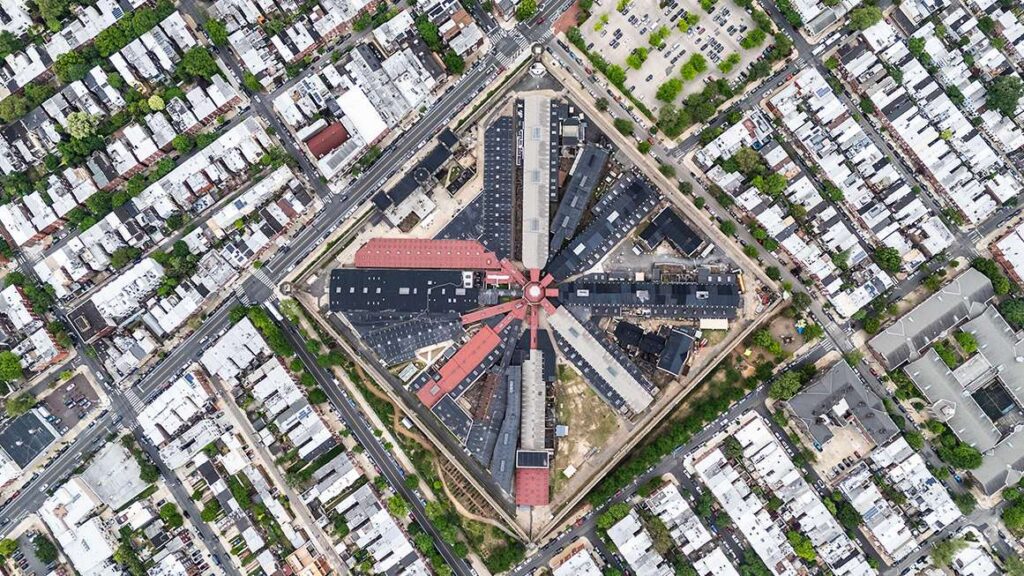
Eastern State Penitentiary is one of the places where the American prison experiment began, and where one of its most bizarre iterations was tested on human beings. After it opened in 1829, Eastern State was, as it is now, a tourist attraction. In 1858, more than 10,000 visitors paid entry fees to gawk at the building and the men confined inside it.
The walls are what everyone sees first when they come to Eastern State. The prison, located on a rise in what is now Philadelphia’s Fairmount neighborhood, is skirted by imposing 30-foot-high granite walls, crenelated turrets, and a medieval gatehouse. It was designed to intimidate, and it has always done its job.
Photo: Eastern State Penitentiary, Philadelphia, Pennsylvania; Roy Johnson/Alamy
When the Marquis de Lafayette, a hero of the American and French revolutions, passed through Philadelphia on an 1824 tour of all 24 U.S. states, city leaders showed him the facade of Eastern State, then still under construction. According to all accounts, Lafayette recoiled at the sight. Thomas B. McElwee wrote in an 1835 history of the prison that the “form of the edifice was disapproved by LaFayette, in the memorable expression which he uttered as he crossed its threshold for the first time, ‘What! Have you Bastilles in this country?'”
Eastern State cost $780,000 to construct, making it one of the most expensive buildings in the country when it opened and one of the most expensive in the world. The paradox of the place was that this fearsome fortress represented the liberal ideals of the young American republic and an investment in building a more humane justice system.
“Prisons were really supposed to be these republican machines,” says Ashley T. Rubin, an associate professor at the University of Hawaii at Mānoa and author of The Deviant Prison, a history of Eastern State Penitentiary. “Crime was one of the main ways that you could basically corrupt the nation, because virtue was essential to what it meant to be a good republican, and criminals are by definition not virtuous, so we had to make them into virtuous citizens.”
What drew visiting dignitaries, Enlightenment intellectuals, and everyday lookie-loos to Eastern State after it opened—and what still draws tourists today—was the unprecedented experiment to produce virtuous citizens behind its walls.
It’s an experiment that continues, in fits and starts, today.
Last year President Donald Trump announced to the surprise of everyone that Alcatraz prison would be reopened. “The reopening of ALCATRAZ will serve as a symbol of Law, Order, and JUSTICE,” the president posted on social media.
The news was unexpected, not just because the island prison is currently under National Park Service management and has been rusting to pieces in the salt air of San Francisco Bay for decades, but because the federal Bureau of Prisons (BOP) has been in a yearslong decline and can barely staff its existing prisons. The BOP has almost 6,000 fewer staff than its target number, and many of its facilities are, if not as decrepit as Alcatraz, in need of serious repairs.
Nevertheless, the White House requested $152 million from Congress this April to reopen Alcatraz. Whether or not it ever reopens, the efforts are notable because Trump is claiming a national ideology of punishment, symbolized by the notoriously harsh prison. “When we were a more serious Nation, in times past,” Trump wrote, “we did not hesitate to lock up the most dangerous criminals, and keep them far away from anyone they could harm.”
Trump was espousing a particular theory of prisons, one that emphasized pain and punishment. It’s a popular notion. It also happens to be wrong.
Wikimedia
The modern prison is widely considered an American invention, one born out of a peculiar American mix of Christian theology and Enlightenment confidence. Much as the Founding Fathers sought to constrain the passions of majorities and lawmakers through checks and balances, prison advocates in the early republic wanted to use architecture and discipline to mold convicts into productive citizens while avoiding the sadism and spectacle that typified criminal justice in Europe.
Despite those best intentions, our prisons have been the sites of unremitting horrors for 250 years and counting. Administrative whippings and outright torture—such as electrocuting inmates with jerry-rigged crank telephones—persisted until the end of the 1960s. After judges and state oversight boards got too nosy, the punishments moved off the books.
Today multiple state prison systems are in states of crisis as bad as or worse than the BOP. The Justice Department sued the state of Alabama in 2020 over its failure to protect incarcerated people from rampant violence and sexual assault. Despite that, shocking levels of corruption and death have persisted, verging into the macabre. In 2024, multiple families of deceased inmates filed lawsuits alleging that the University of Alabama at Birmingham had, without consent, retained their loved ones’ organs after autopsies for student research. In 2022, a federal judge ruled that Arizona prison officials were deliberately indifferent to appalling and sometimes fatal medical neglect, including a case where a woman’s multiple sclerosis was left untreated until she was nearly completely paralyzed by age 36. “No legitimate humane system would operate in this manner,” Judge Roslyn O. Silver of the U.S. District Court for the District of Arizona concluded.
Yet this is the system that prevails in much of the United States. It has endured since the country’s founding, despite reliable 40- to 50-year cycles of reform. The prison is a problem our republic has never solved in any of its various modes: the Jacksonian Era, the Progressive Era, the wave of prison building in the 1980s that launched the age of mass incarceration, or the attempts over the last decade to roll back mass incarceration’s excesses.
After 250 years of the American prison experiment, we need to ask why we’ve never been able to maintain prison systems compatible with our Constitution or our national ideals. While American prisons were initially designed as reactions to the savagery of European criminal codes, it might be time to examine how some European countries’ rehabilitative models could provide the foundations for the next historic American innovation in criminal justice.
To understand this system, and grapple with both its moral failures and its hold on American society, I traveled to the places where it was born and where it has evolved. I saw solitary confinement cells where people were left to find God or madness, watched incarcerated men ride wild bulls at a rodeo inside a state penitentiary, and talked to a man who saw the best and worst of what’s possible in prison before his life sentence for murder was overturned.
What I found was a country that can’t decide what it wants its prisons to be: civic engines for rehabilitation and character formation, or state warehouses for relentless and remorseless dehumanization. The question of what criminal punishment should look like is one of the longest-running and most significant debates over what America itself stands for.
Reason
BOOK ONE: PROTO-PRISONS AND THE JACKSONIAN ERA (1790–1870)
The American prison experiment has often proceeded as a series of calls and responses, each era a backlash to