The post The Epstein Files, 9/11, and Other Important Matters Obscured by the Iran War appeared first on LewRockwell.
—
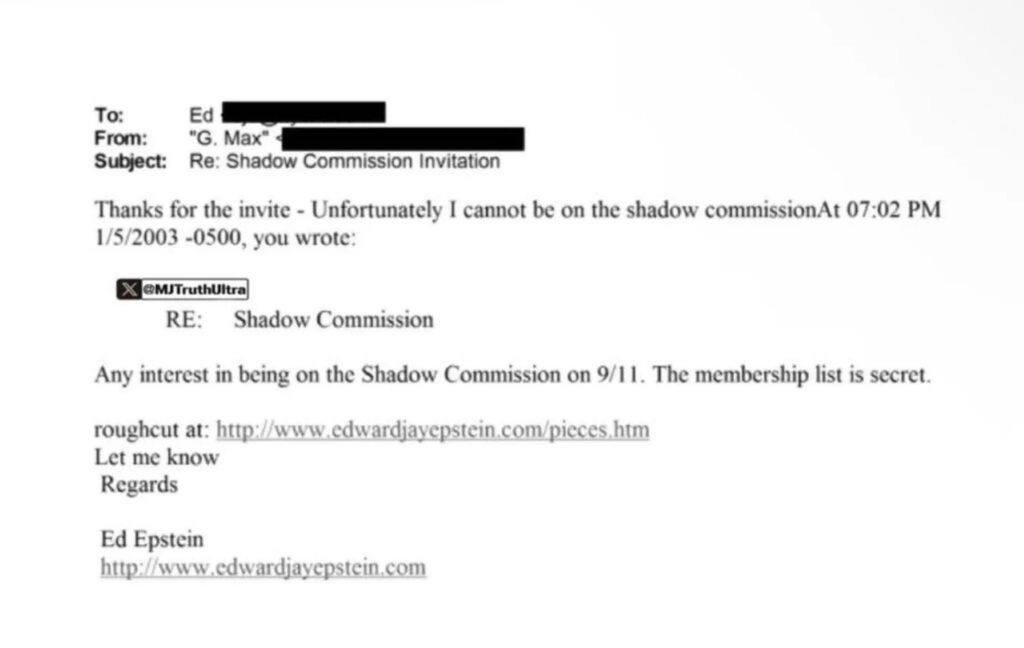
The twenty-fifth anniversary of the 9/11 Attacks will arrive this Friday but I’m not sure how much attention that date will receive.
Those landmark events of a quarter-century ago were certainly among the most important in modern times, constituting the largest and most dramatic terrorist attacks in the history of the world. Indeed, they were arguably far larger than all such previous terrorist attacks combined, and they set into motion a long series of Middle Eastern wars that killed or displaced many millions in that region while costing our own country many trillions of dollars.
The Iraq War was one of the earliest and most important of those. In a recent interview with former New York Times journalist Chris Hedges, Prof. John Mearsheimer explained that the conflict had regularly been ranked by leading academic scholars as the most disastrous blunder in our entire national history.
Video Link
But in that same discussion, Mearsheimer also emphasized that our current war with Iran had easily displaced Iraq at the top of such doleful charts, already having been far worse for our country. And since we are still in the midst of this new conflict, much less attention will probably be paid to that earlier war or to the anniversary of the terrorist attacks that precipitated it.
Over the last few years I’ve written some long articles on the 9/11 Attacks, but I have always emphasized that I was actually very much of a latecomer to the topic. For almost a decade, I’d never really paid much attention to the details of 9/11 let alone to those who were challenging the official narrative or analyzing its major anomalies.
I first explained this in a 2018 article and I have regularly repeated that account on a number of other occasions:
Oddly enough, for many years after 9/11, I paid very little attention to the details of the attacks themselves. I was entirely preoccupied with building my content-archiving software system, and with the little time I could spare for public policy matters, I was totally focused on the ongoing Iraq War disaster, as well as my terrible fears that Bush might at any moment suddenly extend the conflict to Iran. Despite Neocon lies shamelessly echoed by our corrupt media, neither Iraq nor Iran had had anything whatsoever to do with the 9/11 attacks, so those events gradually faded in my consciousness, and I suspect the same was true for most other Americans. Al Qaeda had largely disappeared and Bin Laden was supposedly hiding in a cave somewhere. Despite endless Homeland Security “threat alerts,” there had been no further Islamic terrorism on American soil, and relatively little anywhere else outside of the Iraq charnel house. So the precise details of the 9/11 plots had become almost irrelevant to me.
Others I knew seemed to feel the same way. Virtually all the exchanges I had with my old friend Bill Odom, the three-star general who had run the NSA for Ronald Reagan, had concerned the Iraq War and risk it might spread to Iran, as well as the bitter anger he felt toward Bush’s perversion of his beloved NSA into an extra-constitutional tool of domestic espionage. When the New York Times broke the story of the massive extent of domestic NSA spying, Gen. Odom declared that President Bush should be impeached and NSA Director Michael Hayden court-martialed. But in all the years prior to his untimely passing in 2008, I don’t recall the 9/11 attacks themselves even once coming up as a topic in our discussions.
During those same years, I’d also grown quite friendly with Alexander Cockburn, whose Counterpunch webzine seemed a very rare center of significant opposition to our disastrous foreign policy towards Iraq and Iran. I do recall that he once complained to me in 2006 about the “conspiracy nuts” of the 9/11 Truth movement who were endlessly harassing his publication, and I extended my sympathies. Each of us moves in different political circles, and that brief reference may have been the first and only time I heard of the 9/11 Truthers during that period, causing me to regard them more like an eccentric UFO cult than anything else.
It is perfectly understandable that discussions of dramatic or important events may often be swept aside by even more dramatic and important events.
Indeed, when President Donald Trump launched his war against Iran some especially conspiratorial individuals argued that he was doing so primarily to distract public attention away from the controversy over the Epstein Files.
I was very skeptical of that theory at the time and remain so today. But it’s undeniably true that many important aspects of the Epstein Files story have been ignored because of the overwhelming public focus on Iran throughout most of the last half year.
However, that latter conflict has now receded to a relatively low boil, mostly involving intermittent strikes and counter-strikes. Therefore, I think it’s worth revisiting some aspects of the Epstein Files issue that had come to the forefront just before the outbreak of the Iran War completely swamped all other topics.
For example, less than two weeks before our attack against Iran, I’d published a long article discussing some of the emerging revelations regarding the Epstein Files and the contrasting perspectives presented by Nick Fuentes and Tucker Carlson.
I’d noted that Fuentes had been extremely dismissive of the more conspiratorial interpretations of the Epstein Files, especially including the widespread allegations of pedophilia. He had devoted nearly three hours of his shows to debunking much of that evidence, seeming to do so in quite convincing fashion.
But as I explained, a podcast by Tucker Carlson released around the same time revealed some astonishing facts about the case that completely reversed that conclusion.
At this point I was inclined to dismiss most of the more lurid aspects of the Jeffrey Epstein case as smoke lacking any serious evidence of fire.
But the second show of Fuentes had aired around the same time as one by Tucker Carlson on the same subject, and after I watched the latter my verdict shifted once again.
Carlson’s guest was a researcher named Ian Carroll, previously unknown to me, but clearly someone who had spent a good deal of time carefully investigating the contents of the Epstein Files. And although just like Fuentes, he hadn’t found any explicit smoking guns, certain seemingly innocuous words and phrases that regularly appeared set off massive alarm bells. These included repeated references to simple food items such as pizza and grape soda, but used in a context that didn’t make any logical sense.
Video Link
When I’d published my original 2019 article on Epstein and his activities I’d also discussed the very strange story of the Pizzagate Scandal, in which such food items had seemingly been used as codewords by a ring of politically powerful pedophiles. But perhaps naively, I’d never once suspected at the time that Epstein or his network had any direct connection to Pizzagate, so I was shocked to discover that his own private emails used some of those same exact codewords.
I don’t regularly read the New York Times these days, but on Friday one of their stories on the Epstein Files mentioned that connection:
The document dump also included hundreds of references to pizza, leading several popular conservative commentators to revive Pizzagate, a debunked conspiracy theory from 2016 about a child sex-trafficking ring operating out of the Comet Ping Pong pizzeria in Washington, D.C.
Does it seem plausible that the Epstein Files would contain “hundreds of references to pizza” if the actual food were the intended meaning? Did Epstein and his ultra-elite circle of friends enjoy eating pizza so much that they would constantly mention it in their important emails?
After Trump had reversed himself last year and refused to release the Epstein Files, Carlson had interviewed Darryl Cooper for nearly three hours on the Epstein case, and to their tremendous credit, the last portion of that show had discussed the long-suppressed Pizzagate Scandal in considerable detail. That had probably been one of the very rare times that shocking story had been brought before a national audience since 2016.
Video Link
When the Pizzagate Scandal first erupted in 2016 I’d republished a couple of articles that had attracted a great deal of attention. The sudden arrest of Jeffrey Epstein in 2019 led me to revisit the topic