—
WASHINGTON — The Trump administration this week took a major step towards helping Americans prepare to be parents.
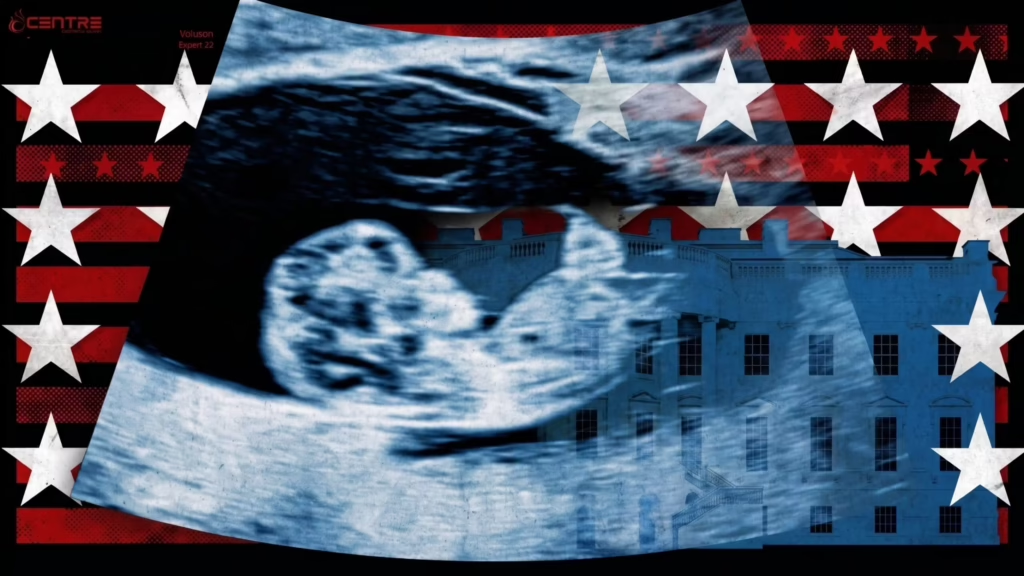
The Department of Health and Human Services announced on Tuesday that unborn children are now considered “candidates for foster care,” The Daily Wire can first report. The move gives expectant parents access to federally-funded services that will help ready them to raise a child. The move builds on the Family First Prevention Services Act, which opened up federal funds for foster parents to parents of children considered candidates for foster care.
Alex J. Adams, Assistant Secretary for the Administration for Children and Families at HHS, tells The Daily Wire that this move is a major step towards realizing the president’s vision of transforming the foster care system.
“He said the best foster care system is the one that is not needed in the first place,” Adams said. “This is designed to protect that family, stabilize that family, keep that child safe, so that foster care is not needed in the first place.”
There are “about 100 different services that qualify for prevention funding” under the Title IV-E Prevention Services Clearinghouse, Adams says. “Everything from medications for opioid use disorder, to home visiting.” By giving expectant parents access to mental health and substance abuse treatment as well as parenting services, the Trump administration believes it can encourage parents to keep children they would otherwise enter into the foster care system.
“The evidence is clear that creating stable, predictable environments and healthy daily routines for children is essential for their long-term well-being and the prevention of chronic health conditions long-term,” Dr. Stephanie Haridopolos, Director of National Health Communications for the Office of the Surgeon General, said in a statement on Tuesday. “This program is one of the best ways we can support unborn children and their expectant parents by preparing them before their baby even arrives.”
States are reimbursed by the federal government for providing preventive services, which include things not typically covered by payers like Medicaid. Those services are available to individuals regardless of income level, HHS notes.
A bipartisan group of 29 states has repeatedly asked the federal government to define expectant parents, specifically pregnant mothers, whose children might be at risk of entry into foster care, Adams says: about one in five children entering foster care is under the age of one.
“So pregnancy is one of those critical moments where, if services could be targeted there, conceivably you could prevent a lot more of those infants from entering foster care,” he explains. “You could stabilize families and keep children safe.”