—
Ever since Bernie Sanders and Donald Trump crashed through the gates of American politics in 2015, the professional moderates of both major political parties have twisted their ears toward the dreaded sound of oncoming hooves.
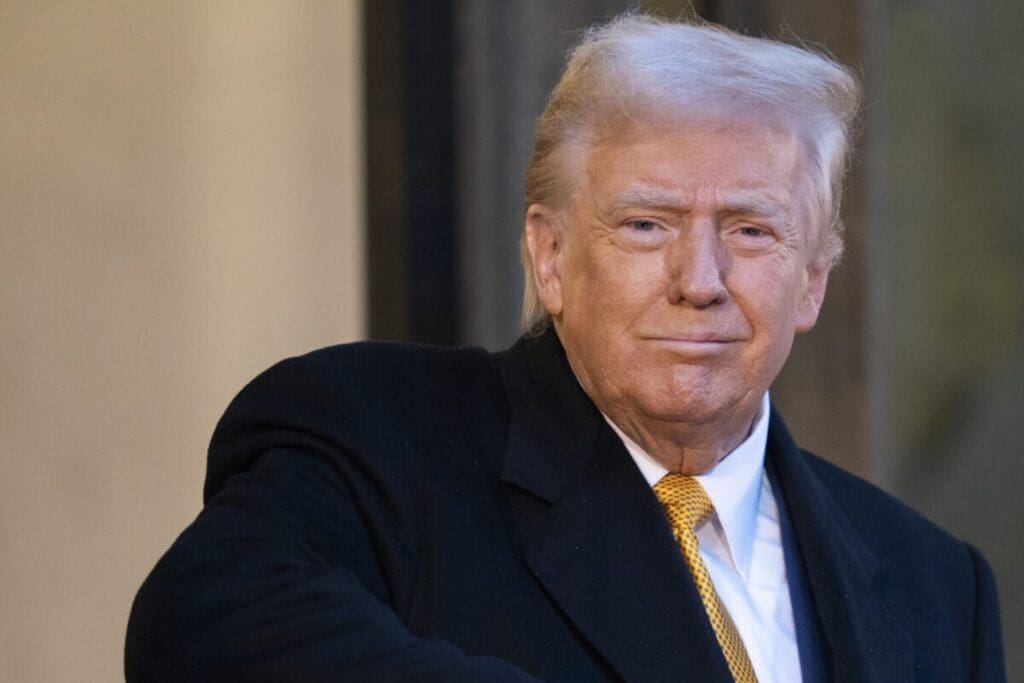
For Republicans, the stampede is an ever-present threat, awaiting irritated instruction from the Oval Office. Even in his waning final-midterm season, Trump in 2026 managed to oust in primaries two sitting United States senators, further cementing his decadelong teardown and reconstruction of the GOP.
For Democrats, the mob has been more sporadic and unpredictable, as in the bolt-out-of-the-blue 2018 New York primary defeat of House Democratic Caucus Chair Joe Crowley by the then-unknown Sanders organizer Alexandria Ocasio-Cortez. AOC is one of just two sitting members of Congress to hail from the Democratic Socialists of America (DSA), a fringe caucus that few paid much heed back then. No longer.
When DSA heartthrob Zohran Mamdani topped a desultory field for New York City mayor in November 2025, it was still possible to shrug off the over-the-top reaction—NYC politics gadfly and Sex and the City veteran Cynthia Nixon calling him a “miracle of nature,” Jon Stewart comparing the son of a movie producer and academic to Jackie Robinson—as a localized virus in a deep-blue city with too much media on its hands. But Mamdani this spring took things national, successfully endorsing in House of Representatives primaries three challengers (two DSA and one former DSA), including one inexperienced, nonsense-spewing candidate who toppled the chair of the Congressional Hispanic Caucus.
AOC’s DSA caucus in the House could conceivably triple in size, with the NYC shoo-ins potentially joined by candidates from Philadelphia, Denver, and Detroit. But the real test of the socialists’ mettle will come in the Senate.
Insurgent blocs within major political parties reveal themselves by showing when they’re willing to lose. The Tea Party during its productive heyday of 2009–13 backed some pretty out-there primary candidates who went on to squander some winnable general elections, such as anti–sharia law crusader Sharron Angle, who face-planted in her attempt to unseat a vulnerable Sen. Harry Reid (D–Nev.). Trump, too, has enforced loyalty by jeopardizing seats, as he did earlier this year by bouncing longtime Sen. John Cornyn (R–Texas) with the abjectly corrupt Texas Attorney General Ken Paxton.
Nothing matters more this year for Democrats—and, arguably, the national electorate—than wresting control of the closely divided Senate, which at press time was almost universally forecast as a 50–50 toss-up. Trump’s final two years in office will look a lot different should the opposition party hold the whip hand on the legislative branch’s oversight and investigatory functions. And yet such is the antipathy of younger Democratic voters toward the perceived crusts of the party’s establishment that the DSA and DSA-adjacent cheerleaders fought viciously to elevate three very flawed candidates to contested statewide Senate elections.
Photo: Sen. Bernie Sanders (I–Vt.), flanked by Rep. Alexandria Ocasio-Cortez (D–N.Y.), speaks in Denver on March 21, 2025; Jesse Paul/The Colorado Sun/Alamy
The first, Maine’s rough-hewn Graham Platner, generated a bewildering-to-outsiders enthusiasm with his billionaire bashing and vituperations against Israel, before eventually withdrawing under a cloud of sexual assault allegations and residual stink over a Nazi tattoo. A second, Florida’s Angie Nixon, won an upset victory over Trump 1.0 resistance hero Alex Vindman by stressing Medicare for All and peace in Gaza, then immediately began distancing herself from the DSA (which she had only recently joined, and which never endorsed her). Regardless of the Democratic primary, incumbent Republican Sen. Ashley Moody is considered the strong favorite.
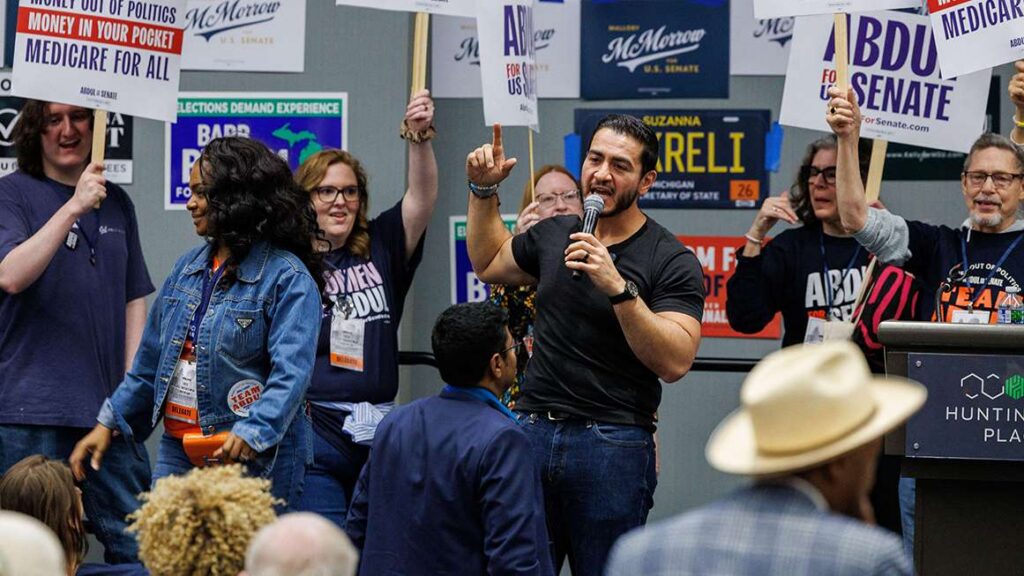
The real center of DSA enthusiasm—and risk—is the third candidate, Michigan’s Abdul El-Sayed, who won a razor-thin primary and is facing a razor-thin general election that could determine the razor-thin control of the Senate. El-Sayed, who combines some of Mamdani’s telegenic charisma with the masculine anger of Platner, is not technically a DSA member (hell hath no fury like the nomenclatural hair splitting of far-left blocs!), but is nonetheless the poster child for the socialistic left in the run-up to November.
What does El-Sayed want? Medicare for All, to bury data centers in a blizzard of burdens and regulations, and above all, to sever America’s tether with Israel, a country he cannot bring himself to affirm should exist. “Every definition of a Jewish state ends up in some articulation of illiberal values,” he told CNN this summer. “Every single one.”
That latter preoccupation has given an opening in this swing state to El-Sayed’s opponent, Mike Rogers, a longtime national security and surveillance hawk–turned Trump toady. Democratic control over the Senate could come down to the perceived antisemitism accompanying the lefty table stakes of decrying Israel as a genocide-committing apartheid state.
Can a mere two handfuls of congressional DSA candidates, including some who are bound to lose, justify the round-the-clock handwringing over the “sexy socialist summer”? Perhaps, yes.
Think back now toward those nervous moderates. How will they modify their behavior so as to keep the populist wolves at bay? House Minority Leader Hakeem Jeffries (D–N.Y.) is facing widespread DSA calls to step aside after saying on Meet the Press that he does not support Medicare for All (a proposal that would be ruinously expensive while criminalizing private insurance plans, among other demerits). Pennsylvania Democratic Gov. Josh Shapiro, a leading party centrist, signed an executive order in August severely restricting data centers, just 14 months after welcoming them with open arms. I had the opportunity recently to ask Sen. Chris Murphy (D–Conn.) the seemingly easy question of whether it’s a good idea for the government to run grocery stores (as it soon will in Mamdani’s New York), and he stammered like a middle schooler who didn’t do the reading.
Numerically minor as it may be, the DSA insurgency is jerking the much larger party leftward on taxing billionaires (including California’s disastrous wealth tax ballot initiative this November), blocking data centers, drastically expanding the already unaffordable entitlement state, and condemning Israel. This remains true even if El-Sayed loses: If you are more likely to lose your job in a primary election than the general, then what matters more is the passion of the grassroots mob, even if that proves to be normie poison.
Hillary Clinton staved off the Sanders challenge in 2016, but then capitulated to his followers on swaths of the Democratic Party platform, particularly on the hoary economic policies the old socialist holds dear. Joe Biden fended off a maniacally woke 2020 Democratic field, and campaigned in the general as a moderate, but then ceded much of his own economic policy to Sen. Elizabeth Warren (D–Mass.) while engaging in whole-of-government initiatives promoting diversity, equity, and inclusion. If the young professional talent in a major political party tilts heavily in a certain direction, then even the graybeards are going to get spun, either as a conscious attempt to fend off an intramural challenge or as mere staffing math.
There is hope yet that prolonged exposure to the Castro-loving, Hamas-apologizing, economically illiterate young fools of the DSA will curdle their electoral fortunes after 10 years (and especially the last 10 months) of growth. But as long as there are out-and-proud socialists winning elections, there’s plenty of work to be done by the anti-socialists of both parties.
The post The Democrats’ Socialist Moment appeared first on Reason Magazine.