—
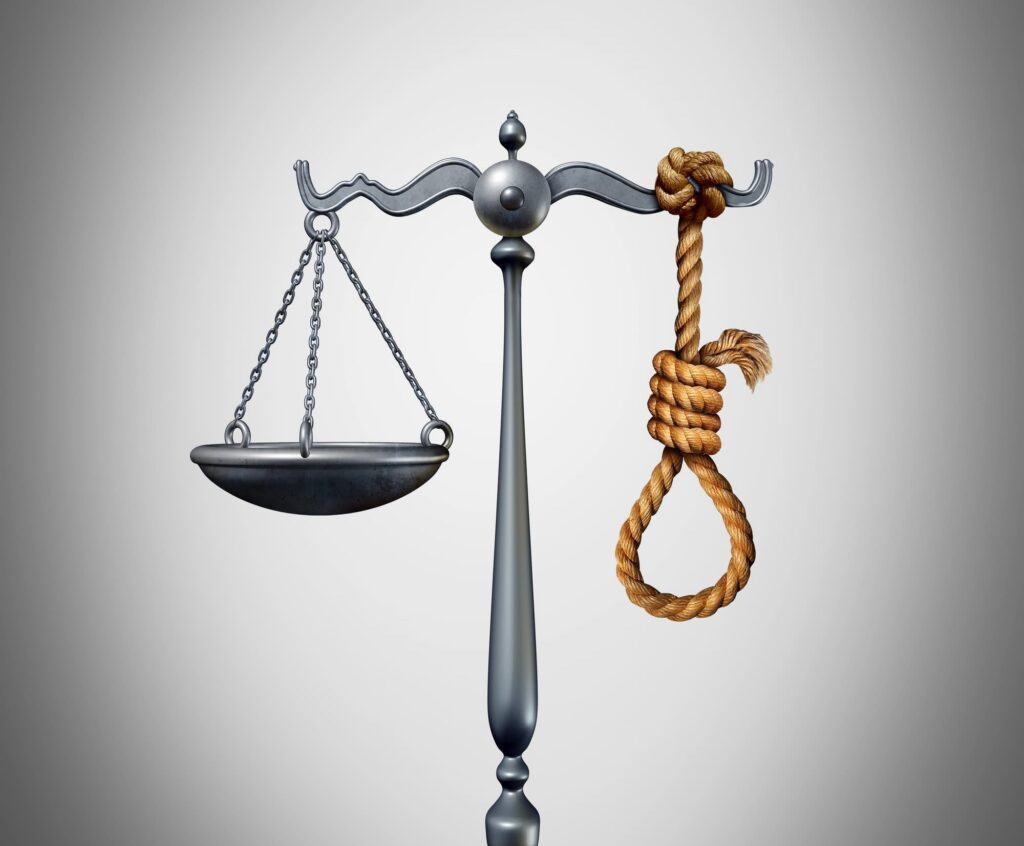
People have been debating what to do with murderers for thousands of years. Plato discussed the contentious matter in his dialogues, and it is likely that disagreement about the proper course of action has existed for as long as there have been murderers. In recent times, the wisdom, efficacy, and morality of the death penalty and state execution of convicted criminals has been vigorously examined in Western democratic societies, with staunch advocates and opponents found on all sides of the multifaceted issue.
The European Union excludes from membership any state which executes even its convicted capital criminals. At the same time, the governments of some EU member states, such as Germany (host of Ramstein Air Base) condone and even materially support the U.S. government’s summary execution without trial of suspected terrorists through the use of lethal drones. Individual politicians, too, may exhibit inconsistency when it comes to the death penalty. Senator Bernie Sanders (I-VT), for example, while claiming to be an opponent to capital punishment in the United States, has also been a full-throated supporter of the use by the military of unmanned aerial combat vehicles (UCAVs) to eliminate unnamed suspects never indicted for their alleged capital crimes, provided that they are residing in societies located abroad.
There are essentially four delineable approaches to the topic of capital punishment based in reason, one is deontological, and the other three are teleological. From the perspective of deontological supporters of the death penalty, convicted murderers should be executed because that is their just desert: “An eye for an eye, a tooth for a tooth.” Deontologists who oppose the death penalty insist that justice cannot be done by eliminating a guilty person who ended the life of an innocent person. There is no moral equivalence whatsoever between the perpetrator and his victim, and the elimination of a guilty person in no way balances the scales of justice. This is a fortiori the case when the murderer has committed mass homicide. The termination of the life of a convicted mass murderer can never rectify what was done to all of his victims and their bereft family members. In this view, to intentionally and premeditatedly terminate the life of a human being is only to repeat the murderer’s own mistake.
On the teleological front, supporters of the death penalty frequently argue that either murderers should be killed in order to deter future persons from murdering other people, or particular convicted murderers must be eliminated so as to protect them from killing anyone else. A third defense of the death penalty by teleologists appeals to economic considerations and a general unwillingness or reluctance to support the life of a convicted criminal through his incarceration in a tax-funded prison.
Those of a teleological persuasion in normative matters who oppose the death penalty retort that no murderer is deterred by the execution of a convicted criminal because people who undertake to commit murder never truly believe that they will be caught. Indeed, in many places the use of the death penalty for crimes less grave than murder has been all but eliminated on the grounds that thieves and rapists, for example, might actually be motivated by the possibility of such a penalty to murder their victims, along with any eyewitnesses present, on what they would regard as grounds of self-defense.
Criminals generally conduct themselves as prudential agents. They make efforts to conceal what they have done, and they do not expect to be apprehended and convicted of their crimes. When murderers are caught, it is nearly always because they have overlooked some piece of incriminating evidence which links them to a corpse. Recent notorious cases, such as that of Caleb Flynn, involve persons who have text-messaged their intentions before committing murder, apparently having been unaware that privacy of electronic communications is a thing of the past.
Teleological opponents to the death penalty furthermore argue that already incarcerated convicts have been sequestered from society and therefore no longer pose a danger to prospective innocent victims. Even within the prison environment, when a vicious, unhinged, in some cases sadistic, criminal poses a clear and present danger, he can be isolated in solitary confinement to protect other persons in the facility, whether guards and other personnel or fellow prisoners.
An economic analysis of the cost of providing the means of sustenance needed to “support” murderers sentenced to life imprisonment is also not a compelling argument, according to opponents of the death penalty, because the lengthy legal processes of appeals permitted under the law would cost much more than the housing and feeding of a convict, even if he were to survive for decades.
A further teleological argument against the death penalty is that murderers can be rehabilitated to some extent, or at least come around to see the error in their ways, but only if they are permitted to continue to live. This approach is sometimes articulated by religious persons and is why a convict on death row may be visited by a priest who hopes to persuade the murderer to confess and profess regret for his crimes before moving on to the next realm, whatever it may be. In the film Dead Man Walking (1995), directed by Tim Robbins, a convicted murderer facing execution comes to admit and morally to regret what he has done. There is a sense in which the film offers an unwitting (?) defense of the death penalty, for the question remains: would he ever have come to recognize his mistake, had his own life not been on the line?
Prisons are filled with convicts who proclaim their innocence and wrongful conviction. A tiny percentage of them are telling the truth, and because human fallibility has led to the erroneous execution of some posthumously exonerated alleged murderers (later determined to have been innocent, as new evidence emerged), some people oppose capital punishment on purely practical grounds: that the only way altogether to avoid committing the worst possible injustice, the termination of the life of an entirely innocent person by the government itself, is to abolish state execution.
What is probably more of an aesthetic than a moral argument for the state execution of capital criminals who have in fact owned up to their crimes may be that some people simply cannot stand the thought of a vicious murderer continuing to live, given what he has done. When prisoners convicted of particularly ghastly crimes are murdered by fellow convicts while incarcerated, this may be the reason in some cases. But most thinkers who debate capital punishment focus on one or more of the above deontological or teleological arguments, whether or not they would label them thus.
It should come as no surprise that officials such as U.S. Secretary of War Pete “Lethality First” Hegseth support capital punishment, for they favor the infliction of that penalty even on suspects never indicted, much less tried and convicted, of any crime. On October 4, 2026, the Pentagon announced with great fanfare yet another obliteration of a boat in the Caribbean sea, claiming that the unidentified persons on board were evil narcoterrorists. The tally of suspects “splashed” under Hegseth’s authority on suspicion of attempting to transport illegal drugs to U.S. shores now exceeds two hundred, even though drug trafficking is not a capital crime in any state or U.S. territory.
Supporters of Hegseth who regularly cheer on the secretary whenever he posts snuff videos of the sinking of boats said to be involved in the narcotics trade are evidently unaware of or oblivious to the fact that people attempting to sell products are not in the business of intentionally killing their customers. It is possible, of course, that the cheerleaders for summary execution of drug trafficking suspects identified through the use of circumstantial evidence as guilty of non-capital crimes are primarily bots funded by the propaganda wing of the Pentagon.
In any case, not satisfied with merely ending the life of convicted capital criminal Nidal Hasan, who did quite intentionally and self-consciously kill thirteen military personnel and injure dozens more at Fort Hood on November 5, 2009, Secretary Hegseth called for his execution by firing squad to be live streamed for all the world to see. Many critics pointed out in response that this sort of public execution is carried out still today only by the governments of Afghanistan, Iran, and North Korea. During the Global War on Terror, people were generally revolted by the videotaped executions of kidnapping victims such as