—
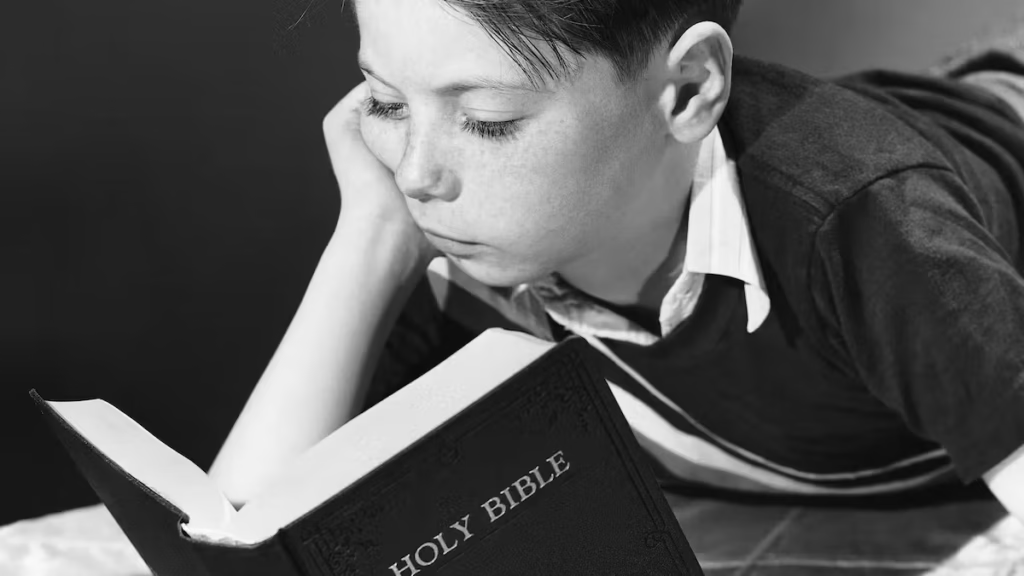
The state of Texas recently implemented a new education curriculum that includes passages from the Old and New Testaments. Committed secularists, liberal and progressive religious leaders, and even many evangelicals quickly pounced on the inclusion of Hebrew and Christian texts in the state’s educational program.
CNN breathlessly warned that “Texas is on the verge of requiring its more than 5 million public school students to study Bible stories, as the state emerges as a leader in a national conservative effort to infuse Christian teachings into American classrooms.” But Texas is not proposing theocracy, or implementing some sort of evangelical proselytization program. It is doing what Americans have done since 1776: ensuring that students have the best and most comprehensive education in order to make them citizens of a republic dedicated to the proposition “that all men are created equal, that they are endowed by their Creator with certain unalienable Rights.”
The American republic just had its 250th birthday, and ever since the 13 colonies cast their lot among the independent and sovereign nations of the world, education has formed a vital part of the United States’ republican identity. Certainly, the new American union saw state churches and the oppressive religious structures of the Old World as a cumbersome inheritance they could, and did, cast off. But that was not something the colonists agreed on at the outset of the American Revolution in 1775, nor was it the reason for their Declaration of Independence in 1776.
The late Joyce Appleby, one of the 20th century’s great historians of the era of American independence, noted that even though the elites who began the war for independence believed the revolution was for a regime dedicated to natural rights, most of those same elites “saw few radical implications in this affirmation of natural rights.” John Adams, George Washington, Alexander Hamilton, and most of the revolutionaries who eventually identified with the Federalist Party “expected continued federance; they supported the authority of patriarchal families, established churches, and legitimate governments.” The Federalists who wrote the United States’ constitution were not secularists, and they were comfortable with the Bible as a essential part of the schooling that made good republican citizens.
Of course, Thomas Jefferson and his Jeffersonian Republicans did work to remove religion from the oversight of government, but not even Jeffersonians believed that the Bible could safely be removed from the sources of knowledge that made educated citizens. And therein lies the basic confusion about what Texas is doing: Secularists, and evangelical Christians, believe learning the Bible is an intrinsically religious act. Reading the Bible is certainly a religious act for Christians and Jews, but the Bible is also a major source of the moral framework of Western Civilization that gives modern Americans the freedoms we enjoy. The reason it is good for Texas’ public school children to know the Bible is the same reason it’s good they know Homer; it’s an important part of the Western canon and a vital piece of the catechesis that creates cultural literacy necessary for liberal democracy.
The Bible is full of the folk tales found in classical Jewish literature; the Old Testament tells of Moses and Pharaoh, David and Goliath, King Solomon’s wisdom, Joshua and the walls of Jericho, Gideon’s small band of warriors, and so much more. Homer’s Iliad and Odyssey tell stories of Achilles, Agamemnon, Hector, Paris, Helen, Odysseus, Penelope, and other figures of Greek mythology. The United States too has its folklore: Pecos Bill, Mike Fink, Daniel Boone, David Crockett, John Henry, and Paul Bunyan are the American versions of those Biblical and Greek figures, and they are all — Hebrew, Greek, and American — important for young Americans to know and learn about. The American republic can only have a healthy society if its citizens are educated enough to know not only that Paul Bunyan, Hercules, and Goliath are all big strong men, but that they are each an example of a very different type of big strong man.
Understanding the moral dimensions of the Bible is vital for the formation of a moral republic. But if secularists, and also some evangelicals, have their way, American students in the 21st century will not have the opportunity to learn the great moral stories their parents and grandparents did. Both groups are arguing that the any reading of the Bible must be a religious act and therefore cannot be done by public schools. This proposition is a twin form of religious and secular fundamentalism that says a pupil cannot study the Bible as literature. The Bible is one of the greatest, if not the greatest, sources of moral literature the West has. It would be a grave mistake to rob American students of its moral and literary influence. Texas has decided to give that gift to its public school students. Other states should do the same.
***
Miles Smith IV is an associate professor of history at Hillsdale College.
This article is part of Upstream, The Daily Wire’s new home for culture and lifestyle. Real human insight and human stories — from our featured writers to you.